Is your practice ready for the Health Professionals and Support Services Award 2020 changes?
A significant change to the Health Professionals and Support Services Award 2020 (the Award) takes effect from the first full pay period starting on or after 1 October 2026.
For healthcare and allied health practice owners, this is not simply another increase to minimum Award rates. A new classification structure will also apply to health professional employees covered by the Award.
Read More
Practice owners: 5 agreement risks to check before the credit card surcharge ban starts
From 1 October 2026, bank card surcharging will change significantly for Australian businesses, including medical and allied health practices. Following its review of merchant card payment costs, the Reserve Bank of Australia (RBA) has removed restrictions that previously prevented designated card networks from imposing “no-surcharge” rules. EFTPOS, Mastercard and Visa have announced that card surcharges will no longer be permitted on their networks from
Read More
Practice owners: The Partnered Health cyber breach is a warning to test your privacy response now
Healthcare practices hold some of the most sensitive information about Australians. When that information is accessed in a cyber incident, the consequences for patients can extend well beyond simply replacing a password or cancelling a bank card.
Read More
Practice owners: Why your compliance checklist has doubled (and what you cannot afford to overlook)
Most healthcare practice owners believe they are broadly compliant.
They have practitioner agreements in place, privacy documentation and employment contracts. They have been operating successfully for years and assume that if nothing has gone wrong, their compliance framework must still be fit for purpose.
Increasingly, that assumption is proving to be incorrect.
Read More
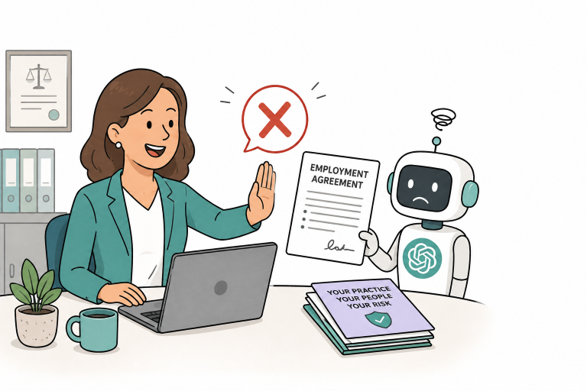
Why ChatGPT Shouldn’t Be Writing Your Employment Agreements
AI tools such as ChatGPT can produce employment agreements that look polished and professional. But polished is not the same as compliant. Here is why healthcare practices should be cautious.
Read More
Privacy, consent and the compliant practice: What the Privacy Act reforms mean for your clinic right now
Most healthcare practices assume their privacy and consent processes are compliant until something tests them.
That test may be a patient complaint, a data breach, an Australian Health Practitioner Regulation Agency (‘AHPRA’) advertising concern, a staff mistake, a website review, or a question from a prospective buyer during due diligence. By that stage, the issue is rarely just the wording of a policy. It is often a gap between what the clinic says it does and what actually happens day to day
Read More
Opening a second clinic? Here’s where most practices get it wrong
For many practice owners, opening a second clinic feels like the next logical step. The first location is operating well, patient demand is growing and expansion appears commercially sensible. In many cases, the second site is secured quickly once the right premises become available.
Read More
Governance, protection and growing bigger: Partnerships, documents and the legal structure that lets you scale
Growth is usually viewed as a positive sign in a medical practice. An expanding practitioner base, additional locations, broader service offerings and increasing revenue may all reflect a practice that is evolving and growing. However, what many practice owners later discover is that growing a practice and strengthening it are not necessarily the same thing.
Read More
The independent practitioner compliance crisis: navigating compliance and structure under new laws
Most medical practices today operate using some form of independent practitioner model. For many years, these arrangements have been seen as commercially efficient, flexible and relatively low risk.
However, practice owners are increasingly coming to us with the same question: “Are our agreements still compliant?” In many cases, the answer is no; not because the agreement structure was inappropriate, but because the devil lies in the detail of the specific terms and conditions of the agreement.
Read More