Why ChatGPT Shouldn’t Be Writing Your Employment Agreements

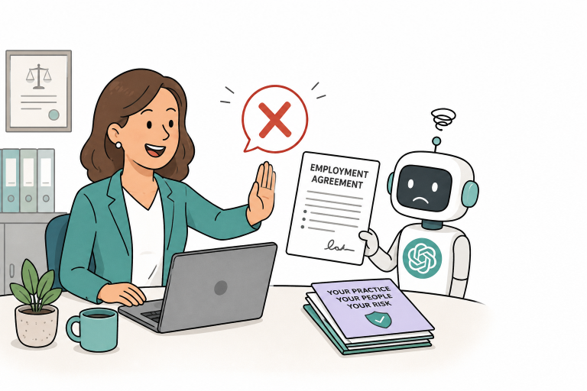
Artificial intelligence is changing the way healthcare businesses operate. From drafting emails and policies to summarising meeting notes, AI tools such as ChatGPT can save significant time on administrative work. Many practice owners are now asking whether these tools can also prepare legal documents such as employment agreements.
It is an understandable question. A well-written AI-generated employment agreement often looks professional. It uses legal language, includes detailed clauses and can appear every bit as comprehensive as a document prepared by a lawyer.
The difficulty is that employment agreements are not judged by how polished they look. They are judged by whether they accurately reflect your workplace, comply with current Australian employment laws and properly allocate legal risk. This is one of the most common issues we see when reviewing agreements that practices have downloaded, generated online or produced using AI.
AI is a valuable business tool, but it should not replace legal advice when creating documents that determine employment rights, payroll obligations and regulatory compliance. For medical practices, the risks extend beyond general employment law and into the complex regulatory environment that governs healthcare businesses.
1. AI often relies on generic or outdated employment clauses
One of the biggest misconceptions about AI-generated contracts is that they are automatically current.
AI generates content based on patterns in the information it has been trained on. It does not verify whether a clause reflects the latest legislation, recent court decisions or changes to industrial relations laws unless it has access to current, verified legal sources and those sources are interpreted correctly.
Employment law changes regularly. Minimum employment standards evolve, modern awards are updated and courts continue to clarify how employment obligations operate in practice.
Many practices are still relying on agreements drafted several years ago. Using AI to rewrite those outdated agreements may simply reproduce the same legal problems in more polished language.
Some common issues include:
- outdated leave provisions;
- incorrect notice periods;
- unenforceable restraint clauses;
- inconsistent probation periods; and
- clauses that conflict with current legislation.
The result may be a document that looks legally sophisticated but creates unnecessary risk if challenged.
2. Employment agreements must comply with the National Employment Standards
Every Australian employment agreement must operate alongside the National Employment Standards (NES). An agreement cannot reduce or remove these minimum legal entitlements.
This is where generic AI drafting frequently creates problems.
For example, AI may include clauses relating to annual leave, personal leave or termination that appear reasonable but do not accurately reflect the NES. In some cases, clauses may inadvertently suggest that employees have fewer rights than the law allows.
Even if those clauses are ultimately unenforceable, they can still expose the employer to disputes, complaints and regulatory scrutiny.
For healthcare practices employing reception staff, nurses, practice managers and administration teams, ensuring agreements align with current employment obligations is essential.
3. AI cannot determine whether your worker is actually an employee
One of the most significant legal characterisation issues in healthcare is whether someone is genuinely an employee or engaged under a properly structured independent practitioner model.
This is not simply a drafting exercise.
It requires careful analysis of how the relationship operates in practice, including:
- who controls the work;
- how patients are managed;
- financial arrangements;
- billing processes;
- operational independence; and
- contractual obligations.
One of the most common issues we see is businesses asking AI to "convert an employee agreement into a contractor agreement."
Unfortunately, changing the heading of the document does not change the legal relationship.
If the operational reality does not support an independent practitioner model, the agreement alone will not protect the practice.
Incorrect characterisation may affect:
- employment entitlements;
- superannuation obligations;
- payroll tax exposure;
- workers compensation; and
- unfair dismissal rights.
This is an area where legal advice focuses on the structure of the relationship, not simply the wording of the contract.
Unsure how your agreements would hold up?
Our team is here to help.
Contact our team Request a call back4. Healthcare practices have obligations that generic AI simply cannot anticipate
Medical practices operate within a highly regulated environment.
An employment agreement for a healthcare business often needs to address issues that would never appear in a standard commercial employment contract.
Depending on the role, agreements may need to deal with:
- patient confidentiality;
- privacy obligations;
- clinical records;
- professional registration requirements;
- AHPRA obligations;
- conflicts of interest;
- use of practice management software;
- infection control responsibilities; and
- intellectual property relating to clinical resources.
These provisions should reflect how the practice actually operates.
A generic AI prompt is unlikely to understand your clinic's governance structure, regulatory obligations or operational workflows.
That is why legal drafting for healthcare businesses is rarely "one size fits all."
5. Polished language creates false confidence
Perhaps the greatest risk is psychological rather than technical.
When AI produces a professional-looking contract, it creates confidence that the document must also be legally correct.
Unfortunately, formatting is not compliance.
We regularly review agreements that contain sophisticated legal language while missing fundamental issues affecting enforceability or regulatory compliance.
Some examples include:
- inconsistent clauses;
- contradictory obligations;
- undefined legal terms;
- references to legislation that no longer applies;
- clauses copied from overseas jurisdictions; and
- obligations that do not reflect the practice's actual operations.
These issues often remain unnoticed until an employee leaves, a dispute arises or a regulator becomes involved.
At that point, fixing the agreement becomes far more expensive than preparing it correctly from the beginning.
6. AI works best as a drafting assistant, not as your legal adviser
None of this means healthcare businesses should avoid AI.
In fact, many practices are already using AI successfully to improve efficiency across administration and operations.
AI can be extremely helpful for:
- summarising lengthy documents;
- generating meeting notes;
- creating training materials; and
- improving internal communications.
The key is understanding where AI adds value and where legal judgement remains essential.
Employment agreements require an assessment of legal risk, commercial objectives and operational reality. These are decisions that depend on context rather than simply generating text.
AI can assist with understanding, but it cannot assume responsibility for ensuring your agreements comply with Australian employment law or accurately reflect how your practice operates.
Why periodic agreement reviews matter
Employment agreements are not documents that should be prepared once and forgotten.
As practices grow, staffing models evolve, technology changes and employment laws develop, agreements should be reviewed to ensure they continue to reflect operational reality.
This is particularly important for healthcare businesses where employment arrangements intersect with privacy obligations, regulatory requirements, payroll tax considerations and clinical governance.
Regular reviews help identify outdated clauses, inconsistencies and legal risks before they become expensive disputes. They also ensure your documentation supports the way your practice actually operates rather than relying on assumptions or generic templates.
For many practices, an agreement prepared only a few years ago may no longer provide the protection they expect.
Whether your employment agreements were drafted years ago, downloaded from a template or generated using AI, now is a good time to review them. Daniela, Senior Lawyer at You Legal, regularly assists healthcare practices with employment agreement reviews that reflect current employment law, healthcare regulation and the operational realities of modern medical practices. If you'd like greater confidence that your agreements protect your practice rather than expose it to unnecessary risk, contact our team today.
Get your employment agreements reviewed
Speak with our specialist healthcare legal team.
Contact our team Request a call back